Showing posts with label Queensland. Show all posts

Sunday, January 27, 2008

Rafting the Russell River

The Russell River rafting trip started with a cup of tea (as most things do in Australia) at the edge of a designated wilderness rainforest. The only way you can raft this particular river is to have absolutely zero environmental impact. So we had to pack in everything – paddles, life vests, rafts on metal poles, an inflatable kayak, ropes, air pumps – along a rough track in the rainforest. Imagine a forest where every tree and animal is unfamiliar, including giant fruit bats, the largest in the world. These bats had wing spans comparable to large birds of prey. We really had to watch our step because wait-a-whiles and stinging nettles were ready to impale us and inject their toxins. We noticed the huge light gaps created in the forest due to blown-down trees during Cyclone Larry. This was particularly noticeable on the higher ground of each rise. Entire tops of trees had been snapped off.

One of the best parts of the trip was at the end of the hike when we arrived at a stream joining the river and were able to sip cool, refreshing, pristine, and highly oxygenated water right from the source with no purification necessary. Wow! Meanwhile, our guides were busy inflating the boats.


Soon we were ready to take off and paddle the river at high water, due to all the recent rain. Our guide showed us all the basic strokes as well as how to hold on so we didn’t fall out of the raft. We navigated 12 rapids in 3 hours – stopping along the way to hike by a waterfall, paint ourselves with ochre, and scout out each rapid to determine the safest route. One of the best rapids was ‘the rollercoaster’ because it consisted of several drops, one right after the other. Everyone must have been holding on really tight, I sure was, because no one fell out of the rafts. At the end of our trip, our guides cooked us a big BBQ meal, which was great because all of us were tired and hungry after paddling such a strong river.

The Russell was pretty amazing. Besides the two rafts and rescue kayak, no one else was on the river. We saw huge mountains rising out of the mist. Rainforest trees were covered in huge epiphytic ferns – a wild and beautiful environment!

Desert Venturer


Most tourists in Australia take a plane to get to the center of the continent. J and I wanted to see the wide open space first hand and witness the change in landscape and vegetation from the coast to the desert. So we opted for a Desert Venture bus trip that allowed us to travel across the land over the course of three days. Due to all the rain in Cairns, we had to take an alternative route the first day in order to avoid the flooded river crossings. We headed south along the Bruce Highway to Cardwell and Townsville and then west on the Flinders Highway for a late picnic lunch at Riedy. Once we got to Charters Towers in the late afternoon, we could really see the change in vegetation. In this semi-arid region eucalypts dominated with an understory of grasses. In contrast to the rainforest near the coast where trees were densely packed, the forest here was more open.

Before stopping at our accommodation for the night we popped into Prairie Hotel , an outback pub with a lot of character. The seats around the bar are a collection of old tractor seats, a dentist chair, and a barber shop chair. Above the bar the owner has displayed every cowboy hat he has ever owned and worn. A potbelly stove provides the heat during cool outback nights and you can relax with a drink in a formal parlor with furniture and décor which take you back to the 1900’s.

Finally, into Hueghdon for the night. After dinner at the motel/pub, J and I enjoyed a stroll around town. Even though none of the shops were open, the store fronts still provided us with a glimpse into the life of this small town. Hueghdon’s big claim to fame is dinosaur fossils – hence the trashcans in town are decorated as big dinosaur feet. The main street hosts a short walk past a fountain, the public library decorated with a silver dinosaur fossil sculpture, the newly built town entertainment center, and public benches flanked with huge former windmills.

Early the next morning we passed a female kangaroo who had been hit and killed during the night. Our driver stopped to pick up the joey because he was still alive in his mother’s pouch. The joey instantly became the center of attention despite the fact he was in pain (both legs were broken), cold, shivering from shock, and hungry. Our driver wrapped him in a towel and we dropped him off at our next stop, Winton, so he could be taken to a vet.

Winton is famous because on a nearby cattle station Banjo Patterson, a well-known Australian poet, was inspired to pen the poem Waltzing Matilda and later set it to music. Australians often joke that they would rather this song be their national anthem rather than Advance Australian Fair. While Waltzing Matilda does invoke images of the Australian landscape and life out in the bush, it is a very sad story of a sheep thief who gets caught and commits suicide in order to avoid police capture – perhaps not something you want your country to be remembered for in an anthem. We spend about an hour walking around Winton and got to the end of the main street … where we just stared at the prairie like landscape. If we had the time it would have been great to strike out in any direction from town, set up a tent, and soak up the landscape. The second impressive feature was Arno’s Wall which is a concrete wall/sculpture with household objects imbedded in it – motorcycles, microwaves, TVs, ovens, stoves, hubcaps, radiators, bottles and other miscellaneous junk!
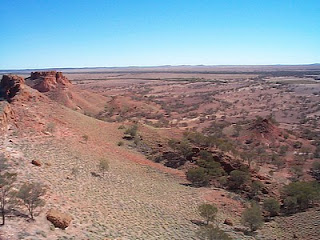
It was getting near lunchtime so we hopped back on the bus and took the Lark Quarry road to Carisbrooke Station, a sheep station larger than some European countries. The road led to the top of the bluff which provided great views of the geology and rocks as well as all the natural water channels running through the country. I have never seen so many dry rivers and channels than during our Desert Venture tour. It is so weird to be nearing a bridge or creek crossing and look out to either side and see absolutely no water. The only way you can tell a river exists is because trees line the banks. On the bluff overlooking Carisbrooke Station I could distinguish an intricate network of channels. Runoff from the bluff provided water for the entire station. Seeing the clumps of spinifex grass and crowns of the trees from above made us realize for the first time why Abroiginal people use dots to characterize the desert landscape.

This station holds another treat as well. One of the rock overhangs contains several rock paintings. We hiked down to get a closer look. Out of all the paintings we would later see, these were the only ones we could really get close to. The images included what looked like plus signs and cross hatching which looked like woven nets. However, these particular paintings are poorly understood because they are not part of a continuous Aboriginal Australian tradition. Aboriginal people who come from these lands do not recognize them and do not claim themselves or their ancestors as the artists.


After a delicious BBQ lunch on the bluff we exited the station via Corkmail Road and saw three huge brolgas, which look like huge cranes with dark necks, standing in the distance. It seemed strange to see birds normally associated with water in the desert, but perhaps the irrigation pond constructed by the station owner had attracted them. We took Lind Road to the Kennedy Highway and eventually stopped at Middleton Hotel, another quirky outback pub literally in the middle of nowhere. Middleton is the home of Lester, an outback Aussie who loves riding and racing wild camels!

Yes, camels were first brought to Australia by Afgans to establish trade routes and haul material across the desert. Over time, a few escaped and the rest is history. Australia is the only country in the world where large populations of camels run wild, and there is a thriving wild camel trade between Australia and Middle Eastern countries. Every year Boulia, another sleepy outback town, hosts camels races. Several years back, Lester, other camel devotes, and their friends and family decided to ride by horse and camel from Winton (home of Waltzing Matilda) to Boulia, a distance of several hundred kilometres. During the two week journey they were really able to lose themselves in the outback landscape and appreciate the huge distances, openness of the sky, texture of the spinifex grass, and reminisce on how people used to travel through this space.


After lingering a bit at Middleton, it was onto the Donahue Highway, a quick stop for a sunset photo, and we pushed onto Boulia and then Wirrilyerna Station for dinner and accommodation.

Dan and Yoli, a husband and wife team who manage a cattle and sheep station, were our hosts for the evening. By now we had seen several kangaroos jumping away from the bus and had even watched a very informative kangaroo documentary. Dan and Yoli had a menagerie of pets enclosed in their front yard and this was J’s first chance to pet a baby kangaroo! It was also at this point where we began to appreciate how cold it gets in the desert when the sun goes down. For the next week we wore every layer of clothing that we had brought and often wished we had remembered to bring mittens and scarves. The flatness and openness of the outback allows you to really see in three hundred sixty degrees. We would appreciate the awesome southern hemisphere sky and the absence of light pollution from large cities for many nights to come.

The next day we got a particularly early start (5 AM) because the turbo-charger has broken the day before and we had to meet the company mechanic, who had left Alice Springs at 3AM and was driving 600 km east to meet us. It’s at a time like this, arranging to meet up with the nearest mechanic who is hours away, that you begin to realize the immensity of the outback. Part of our morning route crossed the Barkley Plains, which consist of red dirt and black organic material left over from dead spinifex grass. This black soil makes excellent road material when it is dry, but becomes quick-sand when it is wet. There were a few clouds in the sky, but none of them told of approaching rain, so we could safely get out of the bus for a ‘nothing walk’, so called because there is absolutely nothing on the horizon for kilometers in any direction. Of course, if you take a look it is obvious that there is ‘something’ present. I could clearly see cattle hoof prints and tufts of spinifex grass that had been nibbled almost to the roots.


Onto the Northern Territory and a stop at Tobbermorey cattle station in order to meet the mechanic and repair the bus. While walking around a bit of the cattle station, this time in the daylight, we could finally appreciate the immensity of these places. Most stations are the size of entire US states or European countries and are very far from towns or settlements of any sort - we wondered how the owners’ social lives adapted to this type of isolation.

The repair was made quickly and soon we were on our way through termite mound country, the largest of which was 9 m high. It’s incredible that tiny insects use their saliva, mud, and excrement to build such huge structures. We snapped a memorable photo in front of the largest mound and then head onto Jervois station for lunch.

Shortly after lunch the bus broke again, this time three fan belts needed to be replaced. But our driver/mechanic said ‘no worries’ as he had spare parts and we enjoyed the desert scenery amongst the red dirt, spinifex grass, and bush tomatoes as repairs were made. Finally, as night fell we were back onto sealed roads (bitumen) – the Plenty Highway and then the Stuart Highway into Alice Springs.

Friday, January 18, 2008

The Wonder of Wetlands

Kyambul Lagoon is not a lagoon in the scientific sense because it is not located along the coast. It is really an oxbow lake, a former river meander, known to Australians as a ‘billabong’. Kyambol Lagoon is in the middle of sugar cane paddocks, but it didn’t always used to be this way.

We were greeted by Caleb* and Harry*, two Aboriginal brothers who are the traditional owners of this place. As young boys they camped along the edge of the lagoon with their parents and grandmother. Back then, the lagoon was surrounded by tropical lowland forest. They camped in humpies, semi-circle tents made out of bark, and enjoyed swimming and tasty bush tucker including numerous barramundi which they caught from the clear lagoon water.


Caleb
is the oldest child in his family and his mother gave birth to him along the shore of the lagoon. The remaining four children were all born in hospitals – a sign of the changing times and the influence of European culture. Miraculously, despite church missions and events such as the stolen generations, when Aboriginal children were often forcibly removed from their parents by the Australian government, Caleb and Harry grew up alongside their parents and their family
remains closely connected to the land. They lived at the edge of the lowland rainforest where the upland rainforest meets the lowland. This is a good spot to live as the lowland rainforest and interspersed paperbark swamp is flooded during the wet season with several meters of water.

Kyambul Lagoon is only accessible during the dry season, once the flood waters recede. The floodplains used to have numerous lagoons, but around the 1950’s the floodplain was cleared for cattle grazing and lagoons were filled in. Caleb recalled that the day when the forest was cleared near the lagoon made his father quite sad and distraught. It happened with no warning and the large trees were toppled and cut up one by one. He watched his country, his soul, being ripped apart and knew that it would never be the same again. Caleb and Harry’s father ran home crying and explained the pain and anguish to his family. At first they couldn’t comprehend what was happening and since they were young children, they didn’t realize the full implications of clearing the land. As Caleb and Harry grew up, more land was cleared and one day they raced to the lagoon to ensure that the heavy machinery did not destroy the grave sites of their grandmother and other family members.

We were impressed that Caleb and Harry swam in the lagoon even though crocs were present. In the past only one croc called the lagoon home. But now that other lagoons in the area have been ploughed over, several crocs have crowded into Kyambul. It turns out you can swim in a lagoon with crocs as long as you stay in the very shallow areas. Caleb also shared with us the technique his father used for hunting crocs. Several men in the community are needed to hunt a big croc. First the men find a nice big ‘wait-a-while’ palm and gather the long tendril embedded with thorns. This plant is so named because if the thorns snag your skin or clothing as you walk near the palm then you will have to wait a while to extract yourself. For similar reasons, this plant is also known as the lawyer vine. Somehow the Aboriginal men held the long tendril in such a way as to not get stuck by the thorns. Then one of them was elected to dive to the spot where the croc was hiding in order to wrap the tendril around the croc’s jaw. Once the tendril was looped around then man would give it a tug and the group on shore would pull the loop shut and wrestle the croc to the surface.

Aboriginal people would control crocodile numbers in other ways as well. Each time female crocs would lay a nest of eggs they would take all but one of the eggs. What we wanted to know was how they distracted a protective mother croc! Croc numbers in the area really plummeted once Europeans began to hunt them, but recently the numbers have rebounded since a no hunting law has been put in place.

Kyambul Lagoon today has water that is milky blue in appearance due to suspended sediments. Several sediment taps have helped to improve water quality by catching fine grain sediments that run off the cane fields during the wet season. In recent years cooperative work among the local land council, traditional owners, and Conservation Volunteers Australia has really improved the lagoon. Rainforest trees have been planted around the lagoon and act as a buffer and help to revitalize the native vegetation that has been displaced by paragrass – a weed planted for cattle grazing that has spread into wetlands and choked water movement. Over a dozen native fish species are present in the lagoon, which is pretty miraculous considering it’s an island surrounded by sugar cane.

The next wetland we visited was one constructed by Richard*, a very forward-thinking farmer, in order to filter water from his cane paddock. Richard has constructed about five wetlands on his property and has helped to finance the construction of several wetlands on his neighbors’ properties – all to ensure good fishing in the surrounding creeks and rivers. An untouched part of his property, which consists of lowland rainforest and paperbark swamp, has been set aside for conservation and he has planted countless trees as riparian vegetation along the numerous creeks which run though his property. It’s really thrilling to know that people are willing to undertake conservation activities on their private property and to see that they have a pronounced affect on water quality and biodiversity.


Of course, it’s not always easy being ‘green.’ Richard faced a lot of opposition and some neighbors thought he was crazy when he constructed his first wetland 20 years ago. But then when they saw how nice it looked with vegetation around the edges and a roosting island for birds in the center, everyone wanted one!

We visited one final land owner, Bill*, who is also a cane farmer. Land Care Australia contacted him about the wetlands on his property and asked him how they could best provide assistance in conserving them, as they are very high value wetlands and form part of the larger Eubenangee Swamp system. In working collaboratively with farmers, Landcare has found ways of reducing fertilizer applications to the fields and thus preventing eutrophication of surrounding wetlands. Otherwise excessive nutrients cause algal blooms which strip wetland waters of oxygen, resulting in fish kills. Riparian tree planting has been incorporated with other routine farm activities so that conservation measure which prevent the erosion of creeks banks are not an inconvenience.

By the time we wrapped up at Bill’s farm the light drizzle had turned to rain, but we were determined to visit Eubenengee Swamp National Park located just down the road. The rainforest portion of the park had been hit quite hard by Cyclone Larry, still it was impressive to see. We were quite in awe of a tree with whitish-yellow spongy bark . At the end of the rainforest we came to a grassy hill forming a lookout point. As we climbed up, the view was spectacular. It’s an entire swamp complex with open water interspersed with sedges and large stands of paperbark for as far as the eye can see. Unfortunately it’s been invaded with an aquatic weed, hymenachne, which reduces the dissolved oxygen present in the swamp water. This plant is very difficult to remove and additional seeds are always supplied by the rivers flowing into the swamp. In some locations the Queensland government has been successful in using a combination of mechanical harvesters, smaller boats, and salt spray to kill and loosen up the tangle of plants.

J and I were completely drenched by the rain at this point and hiked back down to the waiting bus. My head was spinning, not because I was cold and wet, but because it was uplifting and inspiring to hear several environmental success stories…and it was touching to meet the owners first hand. Too often in university settings we talk about including land owners as part of the solution, but don’t often have the opportunity to put abstract concepts into practice.

*Note: Names have been changed to provide anonymity.

Rainforest Conservation at Sugarcane Creek

We packed up and made plans for our next adventure, WWOOFing, which stands for Willing Workers on Organic Farms. Basically it involves staying at a private property - which is usually a farm, but can be bush, a sheep station, or a house with a modest yard – with free room and board in exchange for a few hours of work each day. We booked a bus trip along the coast north to Port Douglas and it turned out to be a beautiful ride. Some of the beaches were occupied by resorts, but most were deserted and covered with sand and large black rocks, which we later learned were former corals. Mangroves were present along more protected shores and impressed us with their prop roots, dense branches and leaves. Mike*, our host, picked us up in Port Douglas and we headed to the grocery store to get supplies for the week. We took a very curvy and swervy ride into the mountains and Atherton Tablelands, including over dirt and gravel roads, to get to his property. We did a short bit of work, graveling a garden path, interspersed with a tour of the bush and rainforest. We were thrilled to be at Sugarcane* Creek!

By working on the property, we could slowly soak up the land and look at it again and again until we had truly been there and not just toured. Cairns has lots of great things to see and do, but everything we saw was seen by thousands before. There is special satisfaction in going somewhere that few people get to go. We also feel that Mike is doing valuable work preserving and enhancing the rare landscapes that exist on his property.

In planning our backpacking trip across Australia we were excited to include several weeks of WWOOFing as a way to meet and get to know several Aussies and give back time and energy to this awesome environment. Our time at Sugarcane Creek fulfilled all of our desires and more. We were very impressed by Mike’s eco-friendly home, which he built himself. It is powered by solar energy, has a composting toilet that requires no water or chemical treatment, and has a grey water system that naturally treats all water used in the home. There are fresh eggs laid daily by the chooks (i.e. chickens) and a vegetable and fruit garden provides all the fresh produce you could ever need. I hope Jonathan and I have an eco-house in the woods some day!

We worked on a variety of projects while at Sugarcane Creek. Much of our time was spentremoving Lanata, an invasive garden shrub (originally from South America) which forms dense walls at the edge of the rainforest. This dense growth smothers existing rainforest trees and prevents new seedlings from growing. We encouraged the growth of grass trees, a rareAustralian plant which grows in open forests, by removing abundant she-oak saplings that were providing too much shade and setting a controlled burn to provide frequent fire. We also finished graveling the garden and rainforest paths.

In our free time we relaxed, read, toured various tracks throughout the property, swum and hiked around Molloy Lagoon, and were treated to lunch at an Aussie pub. I also voraciously read several of Mike’s Australian flora and fauna reference booksand he gave me several botany lessons on the differences between Eucalypts and Melalucas. It was very satisfying to learn more about the land we were travelling through.


The wildlife on the property was also memorable. We spotted a Boyd’s Forest Dragon clinging to the lantana, were greeted by a green tree frog in the dunny (i.e. bathroom), enjoyed the kookaburras laughing at dusk in the front yard, and watched colourful birds flit around at Molloy Lagoon. Going for a night walk and watching sun rise and sunset from a lookout point on the property were well worth it. The sounds of birds and other animals are noticeably different depending on whether it is daylight or night time. The lookout point allowed us to see the rainforest lining the creek as well as the sugarcane paddock of the surrounding properties. The sun glistened off the cane heads in a silvery light.


Once again I was enthralled by the texture of Australian vegetation. The juxtaposition of ‘bush’ versus rainforest was amazing in terms of bark, leaf shape, presence of vines, and openness of the canopy. In one location on the property a paperbark swamp is on one side of the track and rainforest is on the other. It is amazing to look at both distinct ecosystems, each with quite different visual attributes, in one glance.

The biggest challenges we faced were rounding up the chooks at the end of the day, chickens are not the smartest of creatures, and dealing with Clancy the dog who was half Australian cattle dog and half Kelpy. Clancy insisted that he follow us everywhere – in the back of the jeep, to the rainforest edge where we pulled up lantana, and on walks around the property. He did not have the greatest manners – we couldn’t leave clothes or books outside or he would chew them up and every time we went outside we wore our dog ‘armor’ (i.e. old work clothes) because inevitably he would jump up on us. Eventually, after a week, we succeeded in getting him to learn the word ‘off.’

We worked alongside another WWOOFer from France, Elizabeth*. We helped to translate from time to time, but assured Elizabeth that her English was much better than our French. In the evenings the three of us enjoyed cooking up tasty meals and talking over dinner. In a time when there are so many pressing environmental issues, it is great to know that Mike is working so hard to expand the rainforest and manage other special environments on his property. As Mike observed, this is one of the few places in the world where the amount of rainforest is actually increasing. We are pleased and honoured to have been a small part of what goes on at Sugarcane Creek.

*Note: People and place names have been changed to provide anonymity.

Where the Rainforest Meets the Reef

We tried not to get our hopes up too much about seeing the Great Barrier Reef. A couple at the hostel said the portion they saw was pretty trashed out – people had stepped on and smashed some of the corals, other corals were bleached, and overall the reef wasn’t as colorful as they had hoped. However, we couldn’t help getting at least a little excited – we knew that since light gets progressively filtered out by water the deeper you dive, corals at deeper depths look less colorful, but not necessarily because they are damaged.

The Cairns Harbor is surrounded by mountains cloaked in rainforest vegetation which grades into mangroves and in deeper waters corals ring the coastline. Here the rainforest truly does meet the reef. The shades of green and blue are largely unbroken – there are no major roads and just a few houses and fishing shacks. In places the mountains give way to natural harbors complete with quiet swimming beaches.

While snorkelling we discovered a huge brain coral, easily more than a meter in diameter, and small portions were covered in what looked like a slime mould. Elkhorn coral lit up the water with vibrant blues and purples. It grows quickly relative to other coral species and occasionally these tall spikes are broken off by wave action. Soft corals appeared to be bunched up, fluffy, gold carpet reminiscent of the 1970’s. Their tentacles waved gently in the current, creating a wave propagating across the coral from one side to the other.

Coral reefs are underwater forests. Competition for space is fierce because the symbiotic algae that provide the coral with food require sunlight. The table top coral we saw was true to its name - it had a large flat section growing out of a ‘pedestal.’ It was doing a good job of shading out other coral species. Where the table top coral came into direct contact, the other species sported a scar-tissue band, evidence that the chemicals the table top coral produced were effective at opening up new, valuable space.

At Michelmas Kay the majority of the coral is located on the leeward side where the island offers the most protection from prevailing currents and waves. The reef here occurs in very shallow water and several times I got so close that I felt as if I was going to run into it. We saw several sting rays flying across the sandy ocean floor, but even more spectacular were the humongous giant clams at least one to two meters long. The shells were filled with dark purple flesh and two siphons were present – one pumped water in and the other pumped water out.

To some extent one can appreciate the Great Barrier Reef through facts and figures. We learned that one square inch of coral has, on average, 3 million zooxanthellae (the symbiotic algae living in coral) which are smaller than phytoplankton. A bleached coral, which has expelled some zooxanthellae due to rising temperatures, only has about 1 million algae per square inch. Reefs close to the Cairns shoreline are only 10,000-8,000 years old and were formed when rising sea levels inundated the area after the last ice age. Experiencing the reef in-person holds something much deeper however. Swimming over the same corals is delightful because there is always something new to discover – different fish swaying in the ocean’s current, giant clams opening and closing their shells, and coral polyps filtering the water for food.

Other islands such as Fitzroy are not sandy at all but instead are rocky mountain peaks formerly connected to the mainland when the sea level was much lower. Fitzroy Island is littered with huge granite boulders which have broken off the mountain and are lodged against trees or each other. Bird’s nest ferns grow on top of the boulders where soil and leaf litter has accumulated in crevices. The rainforest vegetation allowed us to look back in time and catch glimpses of cycads, ferns, and early conifers which first evolved in Jurassic times when the earth’s continents were connected in one large mass known as “Gondwana.”

Gradually the rainforest on Fitzroy gave way to open forest, or ‘bush’, as Australians call it. Wild bush turkeys were rustling in the leaf litter scratching the soil for food and accumulating large piles of leaves to lay their eggs in a few months time. Numerous lookout points provided views of the shimmering blue ocean, neighboring mountain peaks, and boulders which had tumbled to the beach and were supporting coral reefs. Hazy clouds made it appear as if the sea and sky were one.

The beach on Fitzroy Island is blanketed by several meter thick deposits of broken elkhorn coral. How did these coral pieces break off since it is impossible to break them by hand, we wondered? Then we hit one piece of coral against another – and it broke. During a storm with fast currents and large waves a piece of coral that is already broken off must get lifted up and knock into other corals, causing them to break off in turn. Eventually the coral on the beach is turned into sand by wave action.

Fish at the Fitzroy Island reef were a fusion of color. A school of electric green and blue parrot fish gnawed at algae growing on the coral. In nature’s great recycling process one parrot fish processes several tons of dead coral each year turning huge structures into tiny grains of sand. We were so close to the parrot fish that we could hear the rasping sound. Soft corals waved their tentacles in the current and a more docile orange and white clown fish was hiding in an anemone nearby. We both loved the Great Barrier Reef and Fitzroy Island – it truly was a ‘great’ natural paradise where the rainforest and reef become one.